IoT sensors pay off on farms when they replace guesswork in a decision you make every day: when to irrigate, when to run aerators, when to act on a weather change. A typical setup is a few soil moisture or water quality probes, a solar-powered node that sends readings over the mobile network or a long-range radio such as LoRa, and phone alerts. The hard parts are not the app but calibration, cleaning, power, signal and corrosion, so start with one field or one pond and learn before scaling.
Farmers in the Mekong Delta and the Central Highlands have seen many demonstrations of "smart agriculture". Some systems kept working for years; others stopped within a season because a probe fouled, a battery died or the supplier stopped answering the phone. This guide focuses on what makes the difference.
Start from the decision, not the gadget
Every useful farm sensor answers a question someone is already asking. In a durian or coffee orchard in the dry season, the question is whether the root zone needs water today, and how much. In a shrimp pond, it is whether oxygen will drop dangerously tonight and the aerators need to run longer. In a greenhouse, it is whether temperature and humidity are drifting towards conditions that invite disease.
When a project starts from the gadget, it tends to measure many things and change nothing. Dashboards fill with graphs nobody reads, and after a season the system is quietly abandoned. When it starts from a decision, the design almost writes itself: which value matters, where to measure it, how often, and what action follows a given reading.
Write the decision down in one sentence before buying anything. "If soil moisture at root depth in the upper block falls below the level our adviser recommends, run drip irrigation for that block." "If dissolved oxygen in pond 3 drops towards the danger level at night, send an alarm and switch on the second aerator." Then build only what that sentence needs.
What to measure, and the catch with each
Soil moisture. Capacitive probes last longer than cheap resistive ones, which corrode. Readings depend on soil type, so calibrate against your own soil rather than trusting factory numbers.
Soil temperature and air conditions. Useful for timing fertiliser and spotting heat stress. Shade the air sensor; one in direct sun reports a temperature the crop never experiences.
Rainfall and a small weather station. Local rain data stops irrigation after a shower that the city forecast missed. Keep the rain gauge clear of leaves and bird droppings.
Dissolved oxygen in ponds. The most valuable reading for many aquaculture farms, and the most demanding. Probes need regular cleaning and calibration, or they drift and mislead.
pH, temperature and salinity in water. Helpful for spotting trends after rain or tide changes. pH probes in particular need care and periodic replacement.
Water level in tanks, canals or fields. Ultrasonic or pressure sensors show whether a pump has actually delivered water, and warn about leaks or blocked channels.
Pump and aerator status. A simple current sensor tells you whether a motor is really running, which catches tripped breakers and power cuts at night.
Electricity supply. An alert when grid power fails, especially at night in aquaculture, can matter more than any water quality reading.
Connecting sensors in the field: common options
Coverage on your own land decides this more than any brochure. Walk the site with a phone and test before buying.
| Option | Good for | Limits |
|---|---|---|
| 4G mobile network | Farms with decent phone signal; simple setup with a SIM in each node | Monthly data costs per node; weak signal in low-lying or remote spots |
| LoRa / LoRaWAN long-range radio | Many low-power sensors spread over a large area, reporting to one gateway | Needs a gateway with internet; small data only; setup is more technical |
| Wi-Fi | Greenhouses or ponds close to the house | Short range outdoors; power-hungry for battery nodes |
| Wired connections | Pump houses, control cabinets, fixed equipment | Cable damage from rodents, water and tools; installation effort |
Whichever option you choose, ask what happens to readings when the link drops. Good nodes store data and send it later, and alarms should have a backup such as a local siren.
Power, weather and corrosion: why field systems fail
A sensor that works perfectly on a desk faces a hard life outdoors. Strong sun cooks plastic enclosures and drains batteries faster in heat. Monsoon rain finds every badly sealed cable gland. Brackish water and salty air in coastal provinces corrode metal connectors and screws within months. Lightning in open fields can destroy electronics that are not grounded properly.
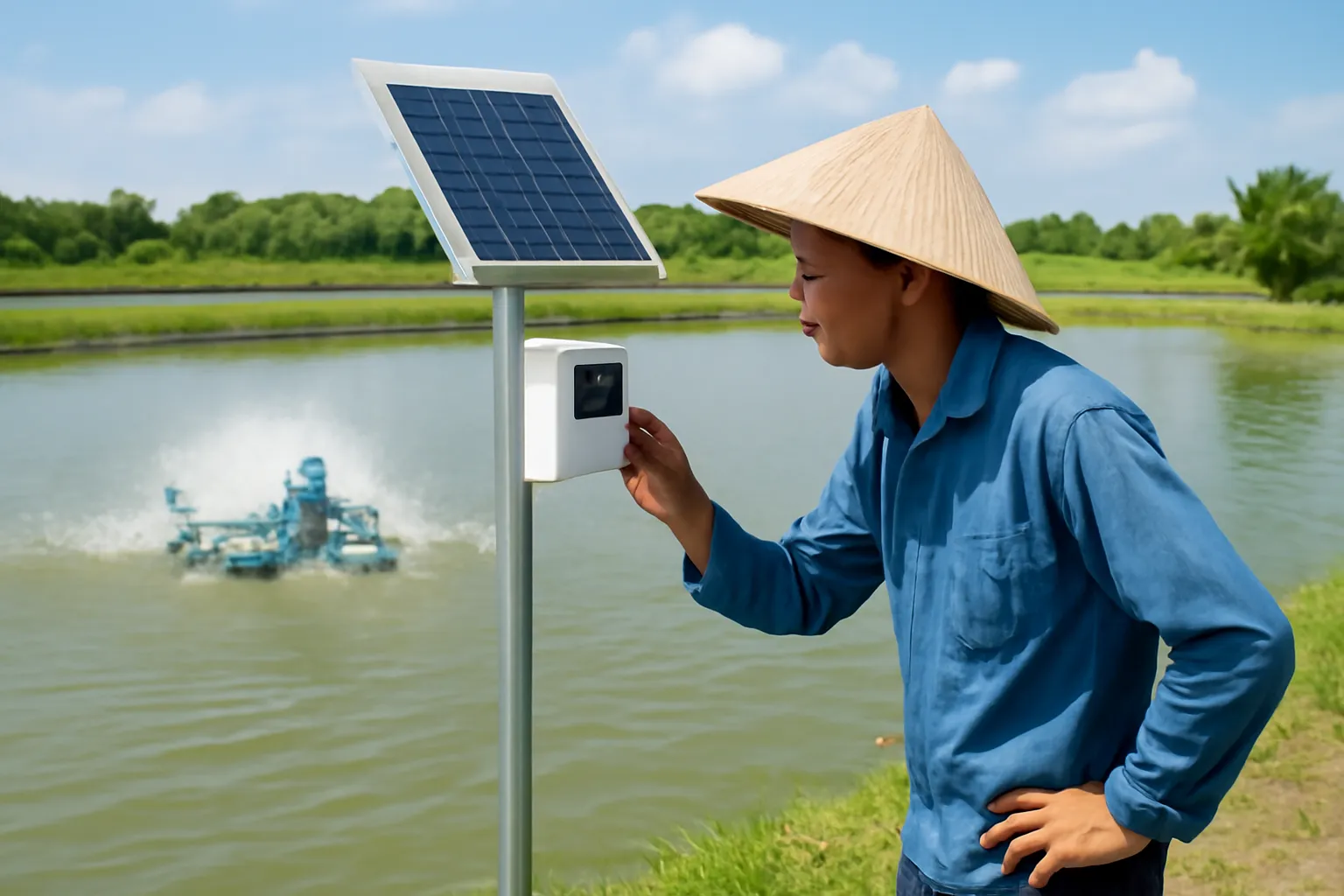
Solar panels with a battery are the usual answer for power, but they must be sized for several cloudy days in a row, not for a sunny afternoon. Panels need cleaning, because dust and bird droppings reduce output, and batteries age and need replacing. Budget for that from the start.
Mount nodes on solid posts above flood level, use enclosures rated for outdoor use, and choose stainless or plastic fittings near salt water. Keep cables short, protected and out of reach of rats and tools. Theft is a real issue in some areas; a simple, unattractive box draws less attention than a shiny one.
Finally, someone has to look after the system. Probes in water foul with algae and silt; soil probes shift when the ground cracks. A system without a named person who cleans and checks it weekly will drift into giving wrong readings, which is worse than no reading at all.
A pilot on one field or one pond
A single, well-run pilot teaches more than a farm-wide rollout that nobody maintains.
- Write the decision you want to improve. One sentence, as above, agreed by whoever actually makes that decision on the farm.
- Get advice on thresholds. Ask your agricultural extension officer, the technical staff of your feed or input supplier, or an experienced neighbour what readings should trigger action for your crop or species.
- Install on one block or pond with a manual comparison. Keep doing your usual checks by hand alongside the sensor so you can see whether they agree.
- Calibrate and clean on a fixed schedule. Follow the supplier's instructions and log each cleaning, so drift can be spotted.
- Review after one season. Did the alerts arrive in time? Did they change what you did? Did you save water, electricity, labour or losses?
- Scale only what proved its worth. Extend the parts that helped; drop the ones that only produced graphs.
Frequently asked questions
Are cheap soil moisture sensors worth it?
Cheap resistive probes corrode quickly and drift, so they suit experiments more than daily decisions. Capacitive probes calibrated for your soil are a better base for irrigation control.
What is LoRa and do I need it?
LoRa is a long-range, low-power radio for sending small readings over large areas to one gateway. It suits farms with many spread-out sensors; for a few nodes near good phone signal, 4G may be simpler.
How often should pond sensors be cleaned?
It depends on the probe and the pond, so follow the supplier's schedule, and clean more often in warm, algae-rich water. Compare with a hand-held meter regularly to catch drift early.
Can sensors automatically control aerators and pumps?
Yes, many systems can switch equipment based on readings, but keep a manual override and alarms in case a sensor fails. A wrong reading should never be able to switch off critical aeration silently.
Where can farmers get advice on thresholds?
Agricultural extension officers, technical staff at feed and input suppliers, research institutes and experienced growers can advise for each crop or species. Thresholds vary by stage and conditions, so avoid copying numbers from unrelated farms.