For a small or medium manufacturer, a smart factory is not a building full of robots. It is a factory that knows, in near real time, what each important machine and line is doing, why it stops, and how much good product it makes, and then uses that knowledge to improve. The practical roadmap starts with measuring downtime and scrap on a few critical machines, moves to connecting those machines to simple dashboards, then to fixing the biggest losses, and only then to automation and robots where the numbers justify them.
Skipping the measuring stage is the most expensive mistake. Factories that buy robots or software first often automate the wrong bottleneck. Factories that measure first usually find that the largest gains come from fewer stoppages and less rework, long before any robot arrives.
What "smart factory" really means for a small manufacturer
Trade fairs and brochures show smart factories as rows of robots, glowing screens and almost no people. That picture belongs to a small number of very large plants making huge volumes of the same product. For a factory with a few dozen machines, a few hundred workers and dozens of product codes, the useful meaning is much simpler.
A smart factory is one where information flows as well as materials. The manager can see which machines are running, which are stopped and why, how many good parts each line made in the last hour, and where defects come from. Decisions about maintenance, staffing and investment are made from that data rather than from memory and shouting across the floor.
Industry 4.0, the label often attached to this idea, combines several technologies: sensors and connected machines, which overlap with IoT; software that collects and analyses production data; automation and robotics; and, increasingly, AI that looks for patterns. None of these has value on its own. They are useful only when they answer a specific production question.
That is good news for smaller manufacturers. The first stages of a smart factory are cheap compared with robots, can be done step by step, and pay back through fewer stoppages and less scrap. The expensive stages come later, and by then you will know exactly where they belong.
Start with the losses you already have every day
Every factory loses production in three broad ways. Machines stop, for breakdowns, missing materials, changeovers or waiting for an operator. Machines run slower than they should, because of small jams, worn tools or cautious settings. And some output is bad, needing rework or ending as scrap.
A common way to combine these three losses is OEE, overall equipment effectiveness. It multiplies availability (how much of the planned time the machine actually ran), performance (how fast it ran compared with its ideal speed) and quality (how much of the output was good). You do not need to love the formula. What matters is that it forces you to look at all three losses instead of only the obvious breakdowns.
Most small factories do not know their real numbers. Paper logs record major breakdowns but miss the many short stops that add up over a shift. Operators round times, and nobody records the twenty minutes spent waiting for a forklift. When factories first measure properly, the result is often uncomfortable, and that discomfort is the starting point of every improvement.
So the first stage of the roadmap is measurement on a few critical machines, usually the bottleneck of the main product line. It can begin with structured paper forms or a tablet at the machine, and later move to automatic signals from the machine itself.
A four-stage roadmap you can follow at your own pace
Each stage builds on the one before. Moving to the next stage before the current one is stable usually wastes money.
| Stage | What you do | Typical tools | What you learn |
|---|---|---|---|
| 1. See | Record stops, reasons, output and scrap on critical machines | Structured forms, tablets, simple counters | Where time and material are really lost |
| 2. Connect | Capture machine signals automatically and show them live | Sensors, machine controller data, a dashboard | Patterns by shift, product and machine |
| 3. Improve | Fix the biggest causes: maintenance, changeovers, material flow | Maintenance plans, standard work, quick changeover methods | Which fixes move the numbers |
| 4. Automate | Add automation or robots at proven bottlenecks | Cobots, conveyors, automated inspection, production software | Whether automation beats the improved manual process |
Many factories find that stage three alone delivers most of the benefit they hoped robots would bring. That is not a failure of the roadmap; it is the roadmap working.
Your first 90 days, step by step
This plan assumes a factory with no production data system today and one manager willing to own the project.
- Choose one line and its bottleneck machine. The bottleneck is the step that limits output. If it is unclear, look for where work in progress piles up.
- Agree on a short list of stop reasons. Eight to twelve reasons, such as breakdown, no material, changeover, quality check, no operator. Too many reasons make operators guess.
- Record every stop longer than a few minutes for four weeks. Start time, end time, reason. Paper is fine at first if someone types it up daily.
- Count good and bad output per shift. Use whatever counting already exists, but make sure scrap and rework are recorded honestly, without blame.
- Review the data weekly with operators and maintenance staff. Show the top three reasons for lost time and ask the people closest to the machine what causes them.
- Fix one cause and measure again. For example, prepare materials before changeovers. Check whether stops really fell.
- Decide whether automatic data capture is worth it. If manual recording is now useful and trusted, connecting the machine directly is a natural next step.
At the end of 90 days you should have a baseline, at least one proven improvement, and a team that sees data as help rather than surveillance.
Where sensors and connected machines help, and where a clipboard is enough
Run and stop signals from machines. Many machines can report when they are running, either from their controller or through a simple current sensor on the motor. This removes guesswork about short stops.
Counting parts automatically. Counters on the machine or optical sensors on a conveyor give reliable output numbers without manual tallies.
Temperature, pressure and vibration on critical equipment. Useful for compressors, ovens, moulding machines and motors where early warning prevents expensive breakdowns.
Energy monitoring. Measuring power use per machine reveals idle equipment left running and abnormal loads that signal wear.
Stop reasons still need people. A sensor knows the machine stopped, not why. A simple button panel or tablet where the operator picks a reason is usually the best combination.
Quality judgement often stays manual. Visual defects on fabric, wood or food are hard to detect automatically without careful testing. Record them by hand until a clear case for automated inspection appears.
Old machines can still be monitored. Machines without digital controllers can be fitted with external sensors. Electrical work must be done by qualified electricians.
A clipboard is fine for rare events. If something happens once a month, a form and a disciplined review may serve better than a new sensor.
Where robots and cobots fit in the roadmap
Robots belong in stage four for a simple reason: they are only worth it at a step that truly limits output or creates heavy, repetitive, risky work. After measuring and improving, you know where that step is. Before measuring, you are guessing, and the guess is often wrong. A factory might automate packing, only to find the real bottleneck was the moulding machine waiting for material.
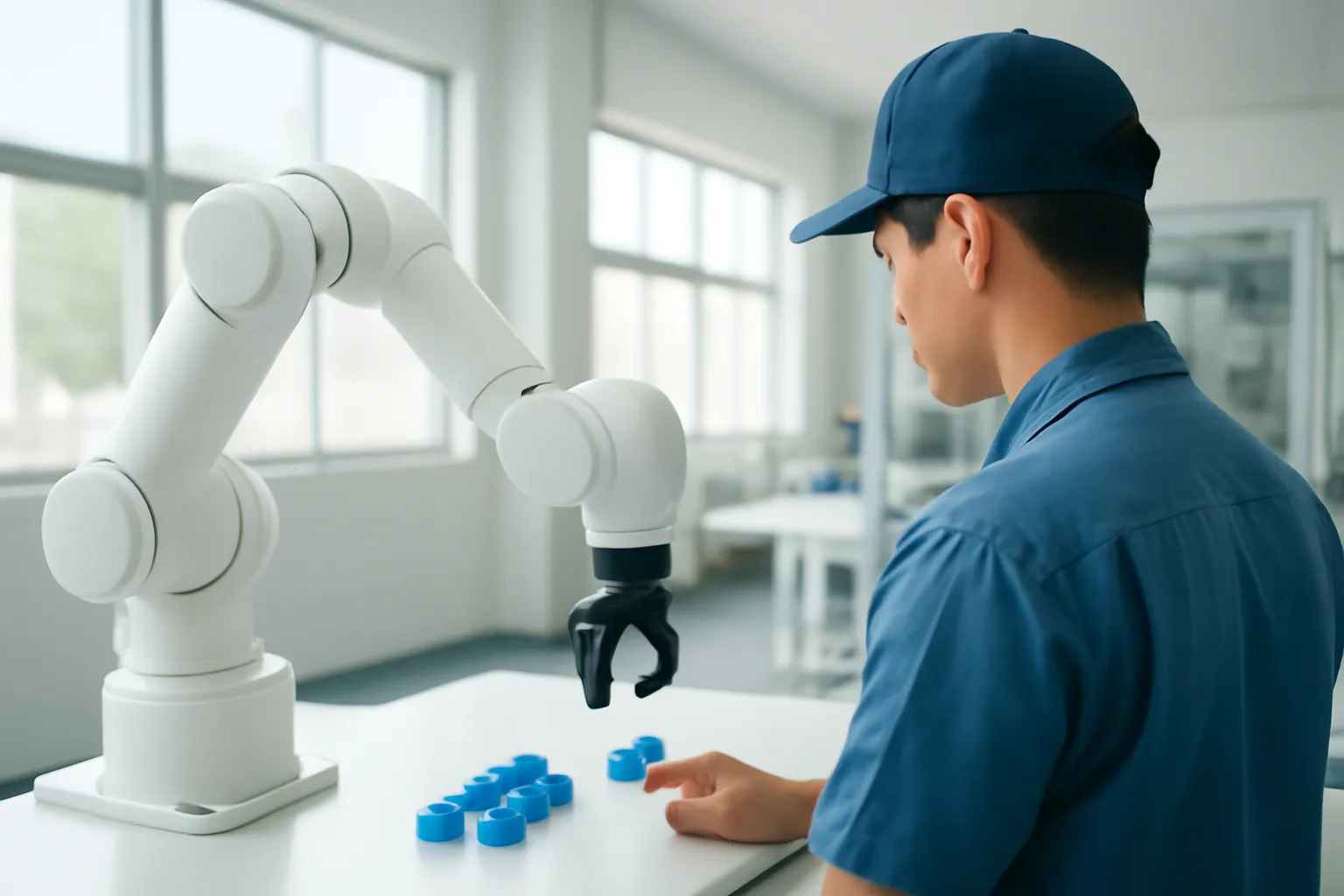
For many smaller factories, the first robot is a collaborative robot loading a machine or packing at the end of a line. The practical side of that choice, including which jobs cobots handle well and how safety assessment works, is covered in our guide to cobots for small factories.
The financial question deserves the same discipline as the technical one. Compare the cost of the robot cell with the value of the extra good output or the labour moved to better work, and include integration, grippers, fixtures, training and maintenance. The method in calculating automation ROI honestly applies to robots as much as to office bots.
Finally, compare automation with the improved manual process, not the old one. If stage three cut stoppages sharply, the bottleneck may have moved, and the robot you planned may no longer be the best use of money.
A worked example: a garment factory
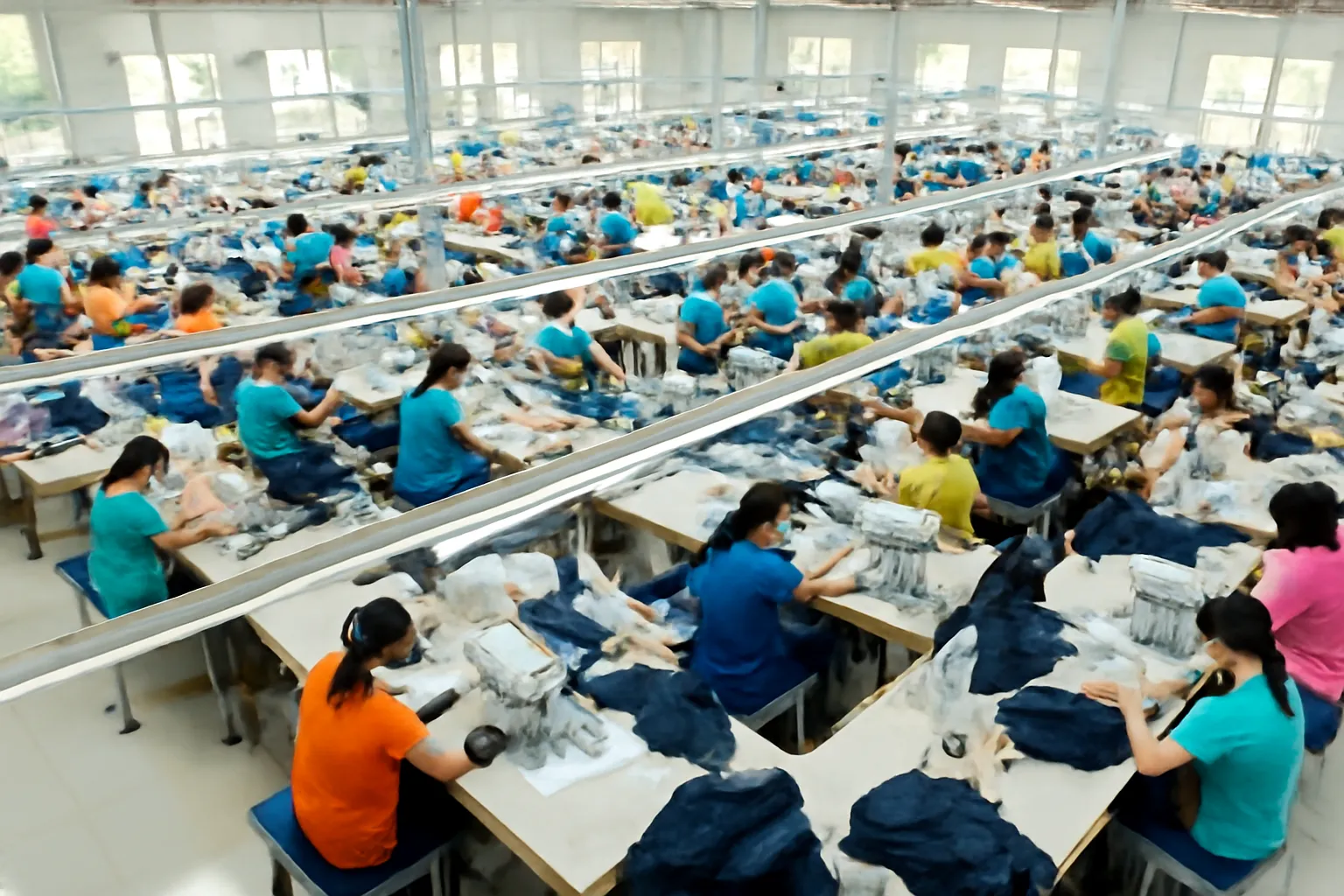
Picture a garment factory in Dong Nai with several sewing lines, a cutting room and a finishing area. Management is under pressure from buyers to deliver faster and with fewer defects, and a supplier has suggested automated sewing units.
The factory starts with stage one instead. On one line, team leaders record every stop longer than a few minutes, and quality inspectors log defects by operation. Within weeks a pattern appears: the line loses far more time waiting for cut pieces and for machine repairs than it does through slow sewing. Defects concentrate in two operations where machine settings drift.
In stage two the factory adds simple run signals on the sewing machines of that line and a screen showing which machines are stopped. Mechanics now see breakdowns immediately instead of waiting to be called. The cutting room gets a daily plan linked to line needs, so cut bundles arrive before the line runs dry.
Only then does automation return to the table, and the first candidate is not sewing at all. It is the cutting room, where an automated cutting process could feed several lines with consistent pieces. Sewing itself, with its soft fabric and frequent style changes, stays largely manual. The roadmap did not reject automation; it pointed it at the right place.
Common mistakes on the way to a smart factory
Buying a dashboard before deciding what question it answers. Screens full of numbers that nobody acts on become wallpaper within months.
Measuring everything at once. Start with one line. Data from twenty machines nobody reviews is worse than data from two machines discussed every week.
Using data to blame operators. If people are punished for recorded stops, they stop recording. Treat stop data as information about the process.
Ignoring maintenance. Many losses come from breakdowns that planned maintenance would prevent. Data often shows this quickly.
Connecting machines to the office network carelessly. Production equipment connected to the internet without separation and changed default passwords creates real security risks.
Letting one vendor lock in all the data. Make sure you can export your own production data in a standard format.
Automating a process that is about to change. New products, layout changes or a planned move can make automation obsolete. Check plans first.
Forgetting training. Supervisors and mechanics need time to learn to read and use the data. Without that, the system is only a cost.
When to bring in specialists
Electrical connection of sensors to machines. Any work inside machine electrical cabinets must be done by qualified electricians following safety rules.
Robot and cobot safety. Risk assessments for robot cells should be led by experienced integrators or safety engineers, and checked against the rules that apply in your location.
Network design and security for production equipment. Separating machine networks from office and internet traffic needs an IT or industrial network specialist.
Choosing production software. For production planning or execution software, ask for references from factories of similar size and product type, and test with your own data.
Machine controller data. Extracting data from machine controllers sometimes needs the machine maker's support. Ask before opening anything that might affect warranty.
Workplace safety and labour rules. Changes to staffing, shifts and safety procedures should be checked with the relevant labour authorities and qualified advisers.
Financing and incentives. If you look at loans or support programmes for technology investment, check current official sources and talk to your bank or accountant, since conditions change.
Security and people: the two things roadmaps forget
When machines become connected, they become part of the company's attack surface. Many industrial devices were designed for closed environments and ship with default passwords and old software. Keep production networks separate from office networks, change default credentials, limit remote access to approved methods, and keep a list of every connected device. Ransomware that reaches a production network can stop a factory, not just its office.
People are the other forgotten element. Operators who feel watched will resist; operators who see that data helps solve their daily frustrations become the best source of ideas. Involve them in choosing stop reasons, show them the results first, and act on what they say.
Supervisors and mechanics need new skills: reading trends, running short problem-solving meetings, using tablets on the floor. That training costs time but is what turns data into improvement.
A smart factory is ultimately a habit: measuring, discussing, improving, and only then investing. The technology makes the habit faster and more precise. It cannot replace it.
Frequently asked questions
Is a smart factory only for large companies?
No. The early stages, measuring losses and connecting a few machines, suit small factories well because they are relatively cheap and pay back through fewer stoppages. Large robot investments can come later, where the data justifies them.
What is OEE in simple terms?
OEE shows how much of a machine's planned time turned into good products at full speed. It combines stoppages, slow running and defects into one picture so none of them is ignored.
Can old machines be part of a smart factory?
Often yes. External sensors can detect running, counts or energy use without replacing the machine. Installation should be done by qualified electricians.
Do we need AI for a smart factory?
Not at the start. Clear data on stoppages and quality, reviewed every week, delivers most early gains. AI can help later with specific problems such as visual inspection or predicting failures, once good data exists.
How do we get workers to accept data collection?
Explain that the data is about the process, never use it to punish, and show quickly that it leads to fixes they asked for. When people see their complaints solved, recording becomes normal.
Is connecting factory machines to the internet risky?
It can be. Keep production networks separate from office and internet traffic, change default passwords and control remote access. Ask an IT or industrial network specialist to review the design.