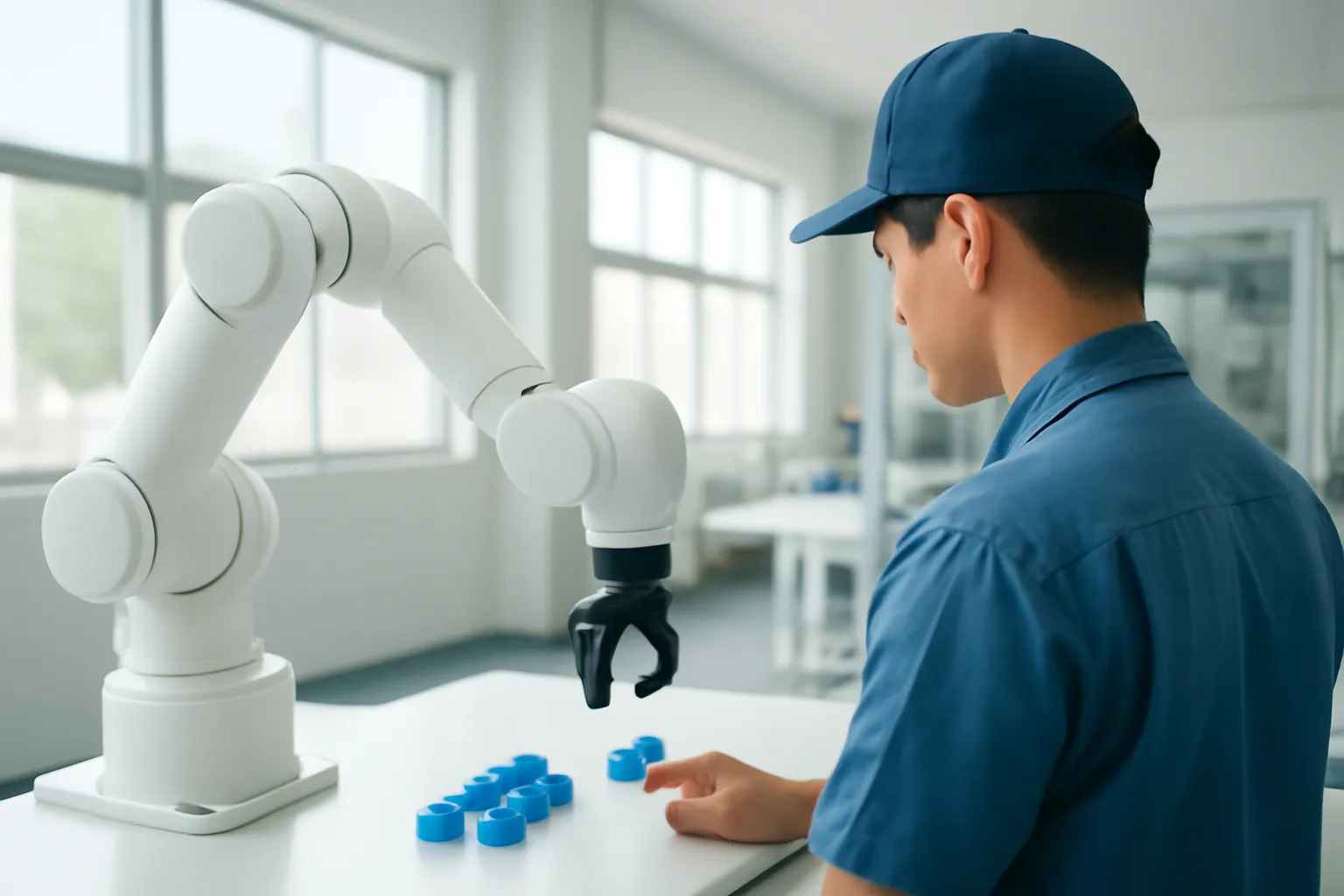
A collaborative robot, or cobot, is a robot arm designed to work near people, usually without a full safety cage, because it is built to limit its force and speed and to stop when it touches something. For a small factory it is most useful for repetitive, light jobs such as loading a machine, packing parts into trays, tightening screws or moving boxes at the end of a line.
A cobot is not automatically safe and not automatically cheap to run. Safety depends on the whole application, including the tool on the end of the arm and the parts it carries, and every installation needs a risk assessment. The arm itself is often the smaller part of the work; grippers, fixtures, programming and changing the workflow around it take most of the effort.
What makes a cobot different from an industrial robot
Traditional industrial robots are fast and strong. They weld car bodies or move heavy loads at speeds that would seriously injure a person, so they live behind fences and stop when someone opens the gate. That works well for large, stable production lines, but the fences take space and the programming usually needs specialists.
Cobots were designed for a different situation. They have sensors that detect unexpected contact, joints and software that limit force and speed, and smoother shapes with fewer pinch points. Many can be taught by physically guiding the arm through a movement and saving the positions, which makes small changes easier for the people already on the factory floor.
The trade-off is that cobots are generally slower and carry lighter loads than industrial robots of similar size. When they work right next to people, they usually must slow down further. A cobot that matches a person's pace is normal; a cobot that outpaces a fenced industrial robot is not.
This is why cobots fit small and medium factories that make many products in smaller batches. The arm can be moved between machines, reprogrammed for a new part, and placed in an existing workspace without rebuilding the line around it.
Jobs cobots handle well
Machine tending. Loading raw parts into a CNC machine, injection moulding press or test station and removing finished ones. The cobot works while the operator handles several machines or checks quality.
Pick and place from organised positions. Moving parts from a tray, conveyor or fixture to another fixed position. The more predictable the part position, the more reliable the job.
End-of-line packing and palletising. Placing boxes on a pallet in a set pattern, within the cobot's payload. Common for food, consumer goods and spare parts.
Screwdriving and simple assembly. Driving screws at fixed points with a suitable electric screwdriver tool. Consistent torque can improve quality as well as speed.
Applying glue or sealant along a path. A steady arm follows the same line every time, which people find tiring to do by hand for a whole shift.
Camera-based inspection. Holding a camera or a part in front of a camera at fixed angles so that defects can be checked consistently.
Sanding and polishing with force control. Some cobots can keep steady pressure on a surface, though dust, tool wear and finish quality need careful testing.
Night or weekend shifts on simple work. Running a stable, well-tested job with fewer staff on site. This still needs monitoring and a plan for stoppages.
Jobs that are harder than they look
Picking jumbled parts from a bin. Finding and gripping parts lying in random positions needs vision systems and clever grippers. It is possible but often the most expensive and fragile part of a project.
Soft or floppy materials. Fabric, plastic bags, cables and food items that change shape are hard to grip reliably. Garment sewing, for example, is still mostly done by hand.
Heavy loads close to the limit. A cobot rated for a certain payload loses speed and precision near that limit, and the gripper weight counts too.
Very high speed lines. If a person already works faster than the cobot's safe speed, the cobot will not keep up without guarding that changes the whole concept.
Tasks with constant judgement. Sorting by look, smell or feel, or deciding whether a slightly damaged item is acceptable, is still better left to trained staff.
Messy upstream processes. If parts arrive in different positions every time, the robot will struggle. Fix the supply of parts first, often with simple fixtures or trays.
Products that change every week. Frequent changeovers are possible, but each one needs new grippers, fixtures or positions. Count that time honestly.
Safety: what actually has to happen
The word "collaborative" describes how a robot is designed, not a guarantee. Safety is decided for each application.
- Do a risk assessment for the whole cell. Look at the arm, the tool, the parts, the table edges, the people nearby and what they do. International robot safety standards describe how; a qualified integrator should lead it.
- Check the tool on the end of the arm. A soft gripper is low risk. A knife, drill, hot glue gun or sharp sheet metal part changes everything, and may require guarding even on a cobot.
- Set speed and force limits for real contact areas. Limits that are acceptable for an arm brushing a shoulder may not be acceptable near the head or hands.
- Add sensing where needed. Area scanners or light curtains can slow or stop the robot when someone comes close, allowing higher speed when nobody is there.
- Train the people around it. Operators need to know how to stop the robot, recover from errors and when not to reach into the work area.
- Review after every change. A new part, new tool or moved table is a new situation. Repeat the assessment rather than assuming the old one still holds.
For legal duties, workplace safety rules and certification in your location, ask a qualified safety engineer and the relevant labour safety authority. Do not rely on a sales brochure.
A realistic first cobot project
Consider a small mechanical workshop that runs two CNC machines making the same metal brackets most of the week. An operator spends much of the shift opening the machine door, taking out a finished part, blowing off chips and loading a new blank.
This is close to an ideal first project. The parts are identical, they can be presented in a simple tray with fixed positions, the gripper is a standard two-finger type, and the operator is freed to measure parts and set up the second machine. The risk assessment focuses on the machine door, the gripper fingers and the sharp edges of the brackets.
The first weeks still bring surprises: chips sticking to the gripper, a tray that slides slightly, a door sensor that needs adjusting. The team keeps a simple log of every stop and its cause, then fixes the most frequent one each week. After a while the stops become rare and predictable.
Notice what this project avoids: random bin picking, soft materials, many product changes and high speed. Those are not impossible, but they belong to later projects, once the team understands how the robot behaves in their workshop.
Frequently asked questions
Can a cobot work without any safety guarding?
Sometimes, but only if the risk assessment for that specific task shows it is acceptable. The tool, the parts and the speed all matter.
Who programs a cobot in a small factory?
Simple moves can often be taught by trained operators by guiding the arm and saving positions. More complex logic, vision or communication with other machines is usually set up by an integrator.
Does a cobot replace a worker?
In most small factories a cobot takes over one repetitive part of a job, and the person moves to setup, quality checks or running more machines. Plan the new role together with the worker.
What is an end effector?
It is the tool attached to the end of the robot arm, such as a gripper, suction cup, screwdriver or camera. Choosing and testing it often takes more effort than choosing the arm.
Should I buy a used cobot?
It can work if the seller provides service history, software access and support for spare parts. Check whether the safety functions can still be updated and verified.